Monetary Policy Rates
As on 21 October 2026
| Rate | Current | Effective from |
|---|
| Policy Repo Rate | 5.50% | w.e.f. 7 October 2026 |
| Standing Deposit Facility (SDF) | 5.25% | w.e.f. 7 October 2026 |
| Marginal Standing Facility (MSF) | 5.75% | w.e.f. 7 October 2026 |
| Bank Rate | 5.75% | w.e.f. 7 October 2026 |
| Cash Reserve Ratio (CRR) | 3.00% | fortnight from 29 Nov 2025 |
| Statutory Liquidity Ratio (SLR) | 18.00% | RBI CRR & SLR Directions, 2025 |
Repo, SDF, MSF and Bank Rate checked against the RBI homepage and 7 October MPC resolution.
CRR and SLR checked against the RBI homepage and official reserve-ratio requirements.
Sources: RBI current rates | RBI MPC resolution | RBI CRR change | RBI reserve ratios
Cover Story
Liquidity tightens: call rate nears the MSF ceiling
19-20 October 2026 | Business Standard (Anjali Kumari), 20 October 2026
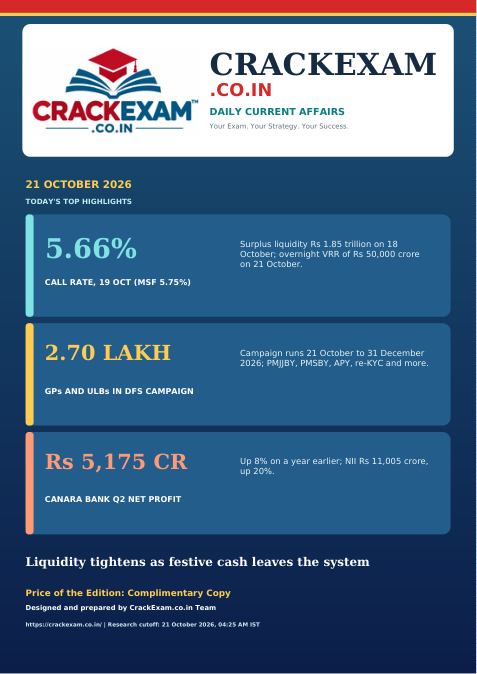
Business Standard reported on 20 October 2026 that the weighted average call rate (WACR) rose to 5.66% on Monday (19 October), close to the 5.75% Marginal Standing Facility (MSF) rate, which is 25 bps above the 5.50% policy repo rate. Net liquidity surplus stood at Rs 1.85 trillion on Sunday, it said.
The paper attributes the turn to currency leakage during the festival season and to the daily cash reserve maintenance requirement, which was tightened from 16 October. Surplus liquidity had been Rs 3.36 trillion in net absorption on 12 October, when the call rate was 5.41%; by 16 October it was below Rs 2 trillion, about 0.7% of deposits.
The RBI's Rs 1 trillion VRR auction on 19 October was the first since 29 July; banks bid Rs 1.51 trillion and the RBI accepted Rs 1 trillion at a weighted average 5.52%. A Rs 50,000 crore overnight VRR was set for 21 October. The RBI had been in absorption mode since 6 August, helped by strong FCNR(B) inflows under its concessional swap facility.
Key facts- WACR 5.66% on 19 October; MSF 5.75%; repo 5.50%
- Net liquidity surplus Rs 1.85 trillion on 18 October (Rs 3.36 trillion net absorbed on 12 October)
- Last VRR before 19 October: 29 July; absorption mode from 6 August; daily CRR maintenance tightened from 16 October
Exam takeaway: The MSF rate is the ceiling of the corridor; a call rate near it signals tight liquidity, which is when VRR auctions become the tool.
Quick revision: WACR 5.66% (19 Oct) near MSF 5.75%; surplus Rs 1.85 trn; VRR auctions resume.
Business Standard (Anjali Kumari), 20 October 2026 original sourceRBI & Regulatory Updates
RBI deletes the limits section on non-option derivative contracts from its commercial-bank and small-finance-bank directions
19 October 2026 | Reserve Bank of India circulars RBI/2026-27/294 and RBI/2026-27/295 (text as reproduced by TaxGuru)
The Reserve Bank of India issued the Reserve Bank of India (Commercial Banks - Miscellaneous) Second Amendment Directions, 2026 (RBI/2026-27/294, DOR.MRG.REC.No.248/00-00-020/2026-27) on 19 October 2026. It deletes Section C, "Limits for Non-Option Derivative Contracts", of Chapter IV of the Commercial Banks - Miscellaneous Directions, 2025 (paragraph 37 of those Directions).
A matching amendment for small finance banks (RBI/2026-27/295, DOR.MRG.REC.No.249/00-00-020/2026-27) deletes the same section from the Small Finance Banks - Miscellaneous Directions, 2025.
Both are issued under Section 35A of the Banking Regulation Act, 1949, after a review, and take effect immediately on issuance. The reproduced text only deletes the section; it does not set replacement limits or a transition period.
Key facts- Circulars dated 19 October 2026: RBI/2026-27/294 (commercial banks) and /295 (small finance banks)
- Deleted: Section C, Limits for Non-Option Derivative Contracts, Chapter IV (para 37)
- Power used: Section 35A, Banking Regulation Act, 1949; effective immediately
Exam takeaway: An amendment direction can be a pure deletion. Read what is removed, the legal power used and the effective date; do not assume a replacement exists.
Quick revision: RBI deleted the non-option derivative limits section (para 37) for commercial banks and SFBs on 19 October 2026.
Reserve Bank of India circulars RBI/2026-27/294 and RBI/2026-27/295 (text as reproduced by TaxGuru) original source RBI/2026-27/295 (small finance banks)RBI & Regulatory Updates
SEBI forms a working group to review the ICDR Regulations for IPOs, FPOs and other issues, Moneycontrol reports
19 October 2026 (report) | Moneycontrol, Brajesh Kumar, 19 October 2026, citing sources (not a SEBI release)
Moneycontrol reported on 19 October 2026, citing industry sources, that the Securities and Exchange Board of India has formed a working group to review the regulations governing initial public offerings (IPOs), follow-on public offerings (FPOs) and other securities issues.
The group will review the SEBI ICDR (Issue of Capital and Disclosure Requirements) Regulations, covering IPOs, FPOs, preferential issues and rights issues. Its mandate, per the report, is to ease and simplify requirements, remove duplicate provisions and make the language clearer.
SEBI Chairman Tuhin Kanta Pandey had earlier announced reviews of the ICDR Regulations and the LODR Regulations. SEBI has also floated a consultation paper on monitoring the use of proceeds raised through public issues.
Key facts- Reported by Moneycontrol citing sources; SEBI had not issued a release in the source read
- Scope: ICDR Regulations - IPOs, FPOs, preferential and rights issues
- Aim: simplify, remove duplication, clearer language
Exam takeaway: ICDR governs how companies raise capital; LODR governs listed-company disclosures. Keep the two apart.
Quick revision: SEBI working group reviewing ICDR (reported, sources-based); aim: simplify and remove duplication.
Moneycontrol, Brajesh Kumar, 19 October 2026, citing sources (not a SEBI release) original sourceBanking & Financial Industry News
Canara Bank Q2 net profit up 8% to Rs 5,175 crore; Canbank Factors sale expected by March
20 October 2026 | PTI report (via Rediff Money), 20 October 2026; Canara Bank regulatory filing as quoted
Canara Bank reported net profit of Rs 5,175 crore for the quarter ended September 2026, up 8% from Rs 4,774 crore a year earlier, per its regulatory filing as quoted by PTI. Total income rose to Rs 40,931 crore from Rs 38,598 crore, interest income to Rs 35,159 crore from Rs 31,544 crore, and net interest income rose 20% to Rs 11,005 crore.
MD & CEO Brajesh Kumar Singh told PTI the sale of subsidiary Canbank Factors, approved by the board on 29 August for Rs 80.5 crore to Vidvedaa Private Ltd, should complete by the end of the third quarter or during the fourth quarter, subject to regulatory approval.
He said the bank replaced part of its high-cost bulk deposits with FCNR deposits (USD 5.8 billion mobilised, per the report), that about 53% of the loan book is repo-linked, and that festive demand should lift retail lending and margins.
Key facts- Q2 FY27 net profit Rs 5,175 crore vs Rs 4,774 crore (+8%); NII Rs 11,005 crore (+20%)
- Canbank Factors sale: Rs 80.5 crore to Vidvedaa Private Ltd; completion by Q3-end or in Q4, subject to regulatory approval
- About 53% of the loan book is repo-linked; FCNR deposits of USD 5.8 billion replaced part of bulk deposits
Exam takeaway: A repo-linked loan book reprices after a repo change; an 8% profit rise alongside 20% NII growth shows other lines (costs, provisions) absorbed part of the gain.
Quick revision: Canara Q2: PAT Rs 5,175 crore (+8%), NII Rs 11,005 crore (+20%); Canbank Factors sale due by March.
PTI report (via Rediff Money), 20 October 2026; Canara Bank regulatory filing as quoted original sourceBanking & Financial Industry News
State-run banks plan three youth products before Diwali and a shared youth portal by end-November, ET reports
21 October 2026 (report) | The Economic Times (Dheeraj Tiwari), 21 October 2026, citing people familiar
The Economic Times reported on 21 October 2026 that public-sector banks plan to launch three products for young customers before Diwali, covering savings, investments, insurance and loans. The move follows Finance Minister Nirmala Sitharaman's direction to banks to strengthen engagement with young people entering the formal financial system.
Features under consideration, per the report, include free demat accounts and financial-planning counselling. A shared portal with interactive features is expected to go live by the end of November. The three products are to carry similar offerings across lenders, and individual banks may add features such as charge waivers or incentives.
Key facts- Three youth products before Diwali: savings, investments, insurance and loans
- Shared youth portal expected by end-November
- Reported from people familiar with the plan; no bank has issued details in the source read
Exam takeaway: This is a reported plan, not a launched product. Quote it as "planned" and attribute it.
Quick revision: PSU banks: three youth products before Diwali; shared portal by end-November (reported).
The Economic Times (Dheeraj Tiwari), 21 October 2026, citing people familiar original sourceEconomy & Financial Awareness
Call rate climbs to 5.66%, near the 5.75% MSF, as festive cash leakage and tighter CRR maintenance shrink surplus liquidity
19-20 October 2026 | Business Standard (Anjali Kumari), 20 October 2026
Business Standard reported on 20 October 2026 that the weighted average call rate (WACR) rose to 5.66% on Monday (19 October), close to the 5.75% Marginal Standing Facility (MSF) rate, which is 25 bps above the 5.50% policy repo rate. Net liquidity surplus stood at Rs 1.85 trillion on Sunday, it said.
The paper attributes the turn to currency leakage during the festival season and to the daily cash reserve maintenance requirement, which was tightened from 16 October. Surplus liquidity had been Rs 3.36 trillion in net absorption on 12 October, when the call rate was 5.41%; by 16 October it was below Rs 2 trillion, about 0.7% of deposits.
The RBI's Rs 1 trillion VRR auction on 19 October was the first since 29 July; banks bid Rs 1.51 trillion and the RBI accepted Rs 1 trillion at a weighted average 5.52%. A Rs 50,000 crore overnight VRR was set for 21 October. The RBI had been in absorption mode since 6 August, helped by strong FCNR(B) inflows under its concessional swap facility.
Key facts- WACR 5.66% on 19 October; MSF 5.75%; repo 5.50%
- Net liquidity surplus Rs 1.85 trillion on 18 October (Rs 3.36 trillion net absorbed on 12 October)
- Last VRR before 19 October: 29 July; absorption mode from 6 August; daily CRR maintenance tightened from 16 October
Exam takeaway: The MSF rate is the ceiling of the corridor; a call rate near it signals tight liquidity, which is when VRR auctions become the tool.
Quick revision: WACR 5.66% (19 Oct) near MSF 5.75%; surplus Rs 1.85 trn; VRR auctions resume.
Business Standard (Anjali Kumari), 20 October 2026 original sourceGovernment Schemes
DFS launches a saturation campaign for financial inclusion schemes from 21 October to 31 December 2026
19 October 2026 (PIB release) | Press Information Bureau, Ministry of Finance (Department of Financial Services), posted 19 October 2026
The Department of Financial Services will run a nationwide campaign for saturation of financial inclusion schemes from 21 October to 31 December 2026, covering 2.70 lakh Gram Panchayats and Urban Local Bodies. Banks will hold camps for the activities listed in the PIB release.
Activities include enrolment under PMJJBY, PMSBY and Atal Pension Yojana; Aadhaar seeding in PMJJBY and PMSBY; opening PMJDY accounts; re-KYC for PMJDY and other savings accounts; generating pending C-KYC IDs; updating nominations in savings accounts and lockers; awareness on digital frauds and on unclaimed financial assets ("Aapki Poonji, Aapka Adhikar"); sourcing KCC applications for eligible PM-Kisan beneficiaries; and Pradhan Mantri Fasal Bima Yojana enrolment to support KCC saturation for the Rabi season.
A preparatory meeting with senior bank management and SLBC was held on 19 October under the Joint Secretary (FI), DFS. Progress is to be monitored by state administrations, banks and DFS.
Key facts- Campaign period: 21 October to 31 December 2026; 2.70 lakh GPs and ULBs
- Camps: PMJJBY, PMSBY, APY enrolment; PMJDY accounts; re-KYC; C-KYC; nominations; fraud and unclaimed-assets awareness; KCC; PMFBY
- Run by DFS with banks; monitored by state administrations, banks and DFS
Exam takeaway: Know the three social-security schemes by cover: PMJJBY (life), PMSBY (accident), APY (pension).
Quick revision: DFS saturation campaign 21 Oct-31 Dec 2026: 2.70 lakh GPs/ULBs; PMJJBY, PMSBY, APY, PMJDY, re-KYC, KCC.
Press Information Bureau, Ministry of Finance (Department of Financial Services), posted 19 October 2026 original sourceCredit/NPA & Risk Management
No verified update for this section today.
National, International & Appointments
RBI SAMVAD 2026: Deputy Governor Poonam Gupta says financial stability now covers the wider system, including non-banks
19-20 October 2026 | ANI via The Tribune, 20 October 2026, citing RBI posts on X
At the Reserve Bank of India's two-day SAMVAD 2026 seminar in New Delhi, speakers flagged geopolitical tensions, increasing use of artificial intelligence and risks from non-bank financial institutions as concerns for financial stability, ANI reported on 20 October 2026, citing the RBI's posts on X.
Deputy Governor Poonam Gupta said financial stability has become a policy objective in its own right, with the focus moving from individual institutions to the wider financial system, including non-banking entities. Participants noted that "crises were now coming quicker and were more intense".
Shaktikanta Das, former RBI Governor, warned that prolonged conflicts and global fragmentation are tightening financial conditions and raising sovereign debt stress, and that untested AI valuations could add to vulnerabilities. DEA Secretary Anuradha Thakur pointed to India's relatively strong position amid global uncertainty.
Key facts- RBI SAMVAD 2026: two-day seminar, New Delhi (opened 19 October 2026)
- Risks flagged: geopolitical fragmentation, AI use and valuations, non-bank institutions, climate, fintech
- Poonam Gupta: financial stability is a policy objective in itself, system-wide
Exam takeaway: Expect questions on the financial-stability objective, systemic risk beyond banks, and who said what at the seminar.
Quick revision: RBI SAMVAD 2026: DG Poonam Gupta - financial stability covers the whole system incl. non-banks.
ANI via The Tribune, 20 October 2026, citing RBI posts on X original sourceKnowledge Article
Why festival season tightens the money market
Business Standard, 20 October 2026; RBI Liquidity Adjustment Facility FAQ
Banks lend to each other overnight in the call money market. The rate they pay, the call rate, normally stays inside the RBI corridor: the Standing Deposit Facility rate (5.25%) at the floor and the Marginal Standing Facility rate (5.75%) at the ceiling, with the policy repo rate (5.50%) in the middle.
Cash leaves the banking system when people withdraw notes for festival spending. This "currency leakage" cuts the deposits banks hold, and so the surplus liquidity in the system. Business Standard also points to the tighter daily CRR maintenance requirement from 16 October.
As surplus falls, banks bid up overnight money. On 19 October the weighted average call rate reached 5.66%, 9 bps below the MSF ceiling. At that point borrowing from the RBI through a Variable Rate Repo auction, where the cut-off was 5.51%, is cheaper than the market.
The RBI had absorbed surplus funds from 6 August (helped by FCNR(B) inflows) and returned to injection with the 19 October VRR, its first since 29 July.
Key facts- Corridor: SDF 5.25% - repo 5.50% - MSF 5.75%
- WACR 5.66% on 19 October 2026; VRR cut-off 5.51%
- Currency leakage and tighter CRR maintenance reduce surplus liquidity
Business Standard, 20 October 2026; RBI Liquidity Adjustment Facility FAQ original sourcePractical Banking Case Study
Reading growth from reported figures: Canara Bank Q2 FY27
Worked example from reported figures (PTI, 20 October 2026); percentages computed here.
Canara Bank reported net profit Rs 5,175 crore (Rs 4,774 crore a year earlier), total income Rs 40,931 crore (Rs 38,598 crore) and interest income Rs 35,159 crore (Rs 31,544 crore).
Working- Profit growth = (5,175 - 4,774) / 4,774 = 8.4%, in line with the reported 8%.
- Total income growth = (40,931 - 38,598) / 38,598 = 6.0%.
- Interest income growth = (35,159 - 31,544) / 31,544 = 11.5%.
- Profit as a share of total income = 5,175 / 40,931 = 12.6%.
Exam takeaway: Always compute growth on the same basis (year on year, same quarter). Interest income grew faster than total income, and NII (Rs 11,005 crore, up 20%) grew faster than profit (up 8%).
Today's Scheme
Pradhan Mantri Jeevan Jyoti Bima Yojana (PMJJBY): features and current terms
Department of Financial Services, Ministry of Finance
PMJJBY is a one-year term life insurance scheme, renewable from year to year, offering life cover for death due to any cause.
Benefit: Rs 2 lakh on the subscriber's death due to any cause. Premium: Rs 436 per annum, paid by auto-debit from the bank or post office account in one instalment. First-time mid-year enrolment allows pro-rata premium: Rs 436 (June-August), Rs 342 (September-November), Rs 228 (December-February), Rs 114 (March-May); renewal is at the full Rs 436.
Eligibility: individual account holders of participating banks or post offices aged 18 to 50; a person with multiple accounts can join through one account only. The cover year runs from 1 June to 31 May. For first-time subscribers, risk starts from the premium auto-debit, and death other than by accident in the first 30 days (lien period) is not covered.
Administered through LIC and other willing life insurers with participating banks or post offices. Assurance ends at age 55, on closure of the account, or if the balance is insufficient to keep the cover in force.
Key facts- Life cover Rs 2 lakh (death due to any cause); premium Rs 436 per year by auto-debit
- Entry age 18-50; cover to age 55; cover year 1 June-31 May; 30-day lien for non-accident death for first-time enrolment
- Pro-rata premium: Rs 342 (Sep-Nov), Rs 228 (Dec-Feb), Rs 114 (Mar-May)
Exam takeaway: Keep the twin schemes apart: PMJJBY is life insurance (Rs 436, Rs 2 lakh, ages 18-50); PMSBY is accident insurance (Rs 20, Rs 2 lakh, ages 18-70). Both are in the DFS campaign running from 21 October.
Department of Financial Services, Ministry of Finance original sourceBank Promotion Exam Corner
Policy rates verified on 21 October 2026 (RBI home page): repo 5.50%, SDF 5.25%, MSF and Bank Rate 5.75%; fixed reverse repo 3.35%; CRR 3.00%; SLR 18.00%.
Money market: WACR 5.66% on 19 October; MSF 5.75%; net liquidity surplus Rs 1.85 trillion on 18 October; overnight VRR Rs 50,000 crore on 21 October (Business Standard, RBI).
RBI deleted Section C (non-option derivative limits, para 37) from the commercial-bank and SFB miscellaneous directions on 19 October (RBI/2026-27/294 and /295).
DFS saturation campaign: 21 October to 31 December 2026; 2.70 lakh GPs and ULBs. PMJJBY: Rs 436, Rs 2 lakh, ages 18-50, cover to 55.
Canara Bank Q2 FY27: net profit Rs 5,175 crore (+8%); NII Rs 11,005 crore (+20%); Canbank Factors sale for Rs 80.5 crore expected by March.
Daily MCQ Challenge
1. On 19 October 2026 the RBI deleted which section from its commercial-bank miscellaneous directions?
A. Priority Sector Lending targets
B. Limits for Non-Option Derivative Contracts
C. Capital adequacy norms
D. Interest rate on savings deposits
Answer: B. The amendment deletes Section C, Limits for Non-Option Derivative Contracts, Chapter IV (paragraph 37).
2. Moneycontrol reported on 19 October 2026 that SEBI formed a working group to review which regulations?
A. Takeover Code only
B. ICDR Regulations
C. Insider Trading Regulations only
D. Mutual Fund Regulations
Answer: B. The group reviews the ICDR Regulations covering IPOs, FPOs, preferential and rights issues.
3. Canara Bank's Q2 FY27 net profit was:
A. Rs 5,175 crore
B. Rs 4,774 crore
C. Rs 11,005 crore
D. Rs 40,931 crore
Answer: A. Net profit Rs 5,175 crore, up 8% from Rs 4,774 crore.
4. State-run banks plan how many youth-focused products before Diwali, per ET?
A. Three
B. One
C. Five
D. Ten
Answer: A. ET reports three products covering savings, investments, insurance and loans.
5. The weighted average call rate on 19 October 2026 was:
A. 5.41%
B. 5.75%
C. 5.25%
D. 5.66%
Answer: D. WACR was 5.66%, near the 5.75% MSF rate.
Revision: recent days
18 October 2026: Earlier edition: ICICI Bank Q2 profit of Rs 148.43 billion is Rs 14,843 crore; keep units straight when a source uses billions.
19 October 2026: Earlier edition: YES Bank's Q2 profit of Rs 1,080 crore and its Rs 5,217 crore pro forma loss answer different questions.
20 October 2026: Earlier edition: the 19 October 7-day VRR allotted Rs 1,00,014 crore against a Rs 1,00,000 crore notified amount; the overnight VRR of 21 October is a separate Rs 50,000 crore operation.
Sources and publication information
The RBI amendment item is from RBI circulars RBI/2026-27/294 and /295 of 19 October 2026 as reproduced by TaxGuru; the RBI notification page itself was not read. The SEBI working-group item is a Moneycontrol report citing sources, not a SEBI release. The Canara Bank item is from a PTI report dated 20 October 2026. The youth-banking item is from The Economic Times, 21 October 2026, citing people familiar. The liquidity item is from Business Standard, 20 October 2026. The campaign item and the PMJJBY box are from PIB (19 October 2026) and the Department of Financial Services. The SAMVAD item is from ANI via The Tribune, 20 October 2026. No verified credit-risk or NPA-specific update appeared on 19-20 October, so that section holds the standing line; a 2024 SEBI circular item and a 2025 Yes Bank article surfaced in search and were excluded as old. Public sources are linked by name, not printed as raw URLs. All questions are original practice.