Monetary Policy Rates
As on 16 October 2026
| Rate | Current | Effective from |
|---|
| Policy Repo Rate | 5.50% | w.e.f. 7 October 2026 |
| Standing Deposit Facility (SDF) | 5.25% | w.e.f. 7 October 2026 |
| Marginal Standing Facility (MSF) | 5.75% | w.e.f. 7 October 2026 |
| Bank Rate | 5.75% | w.e.f. 7 October 2026 |
| Cash Reserve Ratio (CRR) | 3.00% | fortnight from 29 Nov 2025 |
| Statutory Liquidity Ratio (SLR) | 18.00% | RBI CRR & SLR Directions, 2025 |
Repo, SDF, MSF and Bank Rate checked against the RBI homepage and 7 October MPC resolution.
CRR and SLR checked against the RBI homepage and official reserve-ratio requirements.
Sources: RBI current rates | RBI MPC resolution | RBI CRR change | RBI reserve ratios
Cover Story
Reading September labour data without mixing indicators
15 October 2026 (September survey data) | PIB, Ministry of Statistics and Programme Implementation
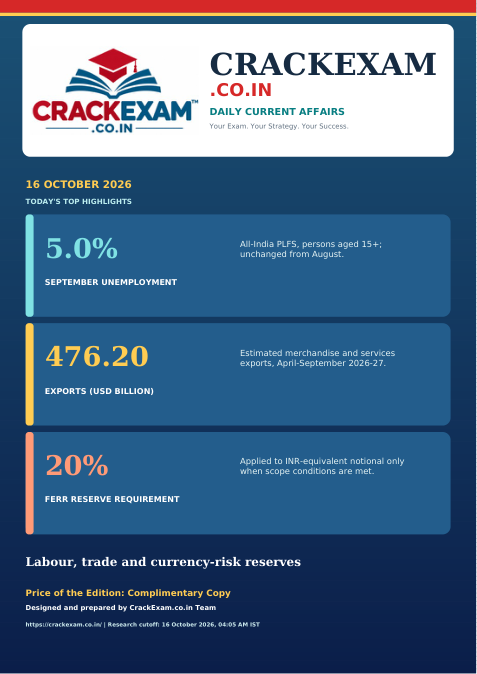
The PLFS monthly bulletin reports an all-India unemployment rate of 5.0% for persons aged 15 years and above in September 2026, unchanged from August and 0.2 percentage points below September 2025.
Labour Force Participation Rate (LFPR) was 55.5%, compared with 55.6% in August. Worker Population Ratio (WPR) was 52.7%, compared with 52.8%. Urban LFPR rose from 50.4% to 50.7%, and urban WPR reached 47.2%.
Urban female LFPR increased from 25.4% to 25.9%, its highest level since October 2025. Rural unemployment was 4.2%, while urban unemployment was 6.9%. Monthly estimates use Current Weekly Status and covered 3,70,513 surveyed persons.
Key facts- Persons aged 15+: LFPR 55.5%; WPR 52.7%; UR 5.0%
- Urban LFPR: 50.7%; urban female LFPR: 25.9%
- Rural UR: 4.2%; urban UR: 6.9%
Exam takeaway: Use the same age group, geography and reference period when comparing labour indicators. A change in participation is not the same as a change in unemployment.
Quick revision: September PLFS: 5.0% UR; urban LFPR 50.7%.
PIB, Ministry of Statistics and Programme Implementation original sourceRBI & Regulatory Updates
RBI overnight VRRR accepts Rs 9,562 crore at 5.49%
15 October 2026 | Reserve Bank of India
The RBI accepted all Rs 9,562 crore offered in its one-day Variable Rate Reverse Repo auction on 15 October 2026. The notified amount was Rs 50,000 crore.
The cut-off rate and weighted average rate were both 5.49%. Partial acceptance did not arise. This is the completed result of the operation announced in the previous edition, not a fresh auction announcement.
Key facts- Notified: Rs 50,000 crore; offered and accepted: Rs 9,562 crore
- Tenor: one day; cut-off and weighted average rate: 5.49%
Exam takeaway: In a VRRR, banks place surplus funds with the RBI. The notified amount is not necessarily the amount actually absorbed.
Quick revision: 15 Oct VRRR: Rs 9,562 crore accepted at 5.49%.
Reserve Bank of India original sourceRBI & Regulatory Updates
States offer Rs 24,400 crore of securities for 19 October auction
15 October 2026 (auction scheduled for 19 October) | Reserve Bank of India
Eleven States and Union Territories offered securities with an aggregate face value of Rs 24,400 crore. The RBI will conduct the auction on E-Kuber on Monday, 19 October 2026; payment by successful bidders is due on Wednesday, 21 October.
Competitive bids are scheduled for 10:30-11:30 AM, and non-competitive bids for 10:30-11:00 AM. Up to 10% of each stock is available under non-competitive bidding, subject to a single-bid limit of 1% of that stock's notified amount.
The minimum nominal investment is Rs 10,000, with multiples of Rs 10,000 thereafter. The securities are eligible for banks' SLR investment. These are auction terms, not completed borrowing or final yields.
Key facts- Aggregate notified face value: Rs 24,400 crore
- Auction: 19 October; payment: 21 October 2026
- Platform: E-Kuber; minimum denomination: Rs 10,000
Exam takeaway: Keep the auction date, settlement date and actual amount raised separate. A reissue uses a price auction; a new stock can use a yield auction.
Quick revision: States: Rs 24,400 crore offered for 19 Oct auction.
Reserve Bank of India original sourceBanking & Financial Industry News
No verified update for this section today.
Economy & Financial Awareness
September unemployment rate steady at 5.0%; urban participation improves
15 October 2026 (September survey data) | PIB, Ministry of Statistics and Programme Implementation
The PLFS monthly bulletin reports an all-India unemployment rate of 5.0% for persons aged 15 years and above in September 2026, unchanged from August and 0.2 percentage points below September 2025.
Labour Force Participation Rate (LFPR) was 55.5%, compared with 55.6% in August. Worker Population Ratio (WPR) was 52.7%, compared with 52.8%. Urban LFPR rose from 50.4% to 50.7%, and urban WPR reached 47.2%.
Urban female LFPR increased from 25.4% to 25.9%, its highest level since October 2025. Rural unemployment was 4.2%, while urban unemployment was 6.9%. Monthly estimates use Current Weekly Status and covered 3,70,513 surveyed persons.
Key facts- Persons aged 15+: LFPR 55.5%; WPR 52.7%; UR 5.0%
- Urban LFPR: 50.7%; urban female LFPR: 25.9%
- Rural UR: 4.2%; urban UR: 6.9%
Exam takeaway: Use the same age group, geography and reference period when comparing labour indicators. A change in participation is not the same as a change in unemployment.
Quick revision: September PLFS: 5.0% UR; urban LFPR 50.7%.
PIB, Ministry of Statistics and Programme Implementation original sourceEconomy & Financial Awareness
April-September total exports estimated at USD 476.20 billion
15 October 2026 | PIB, Department of Commerce
Combined merchandise and services exports for April-September 2026-27 were estimated at USD 476.20 billion, up 13.84% from USD 418.31 billion a year earlier. Imports were estimated at USD 551.13 billion, leaving a combined trade deficit of USD 74.93 billion.
Merchandise exports for the half year were USD 259.89 billion and imports USD 437.53 billion, giving a merchandise deficit of USD 177.64 billion. The services surplus, estimated at USD 102.71 billion, partly offset that goods deficit.
For September alone, total exports were estimated at USD 80.75 billion and imports USD 94.05 billion. The release explicitly marks September services figures as estimates because the latest RBI services data available were for August.
Key facts- April-September exports: USD 476.20 billion; growth: 13.84%
- Combined deficit: USD 74.93 billion; merchandise deficit: USD 177.64 billion
- Estimated services surplus: USD 102.71 billion
Exam takeaway: A merchandise trade deficit excludes services. A combined trade deficit still differs from the balance of payments current account, which includes other components.
Quick revision: Half-year exports: USD 476.20 billion, estimated.
PIB, Department of Commerce original sourceGovernment Schemes
National Strategic Trade Command Centre launched in New Delhi
15 October 2026 | PIB, Department of Commerce
Union Commerce and Industry Minister Piyush Goyal launched the National Strategic Trade Command Centre (NSTCC) at Vanijya Bhawan, New Delhi. The Department of Commerce developed the initiative for monitoring trade, regulatory approvals and operational indicators.
Initial dashboards cover DGFT functions such as Importer Exporter Code, Advance Authorisation, Export Promotion Capital Goods, Certificate of Origin and SCOMET. Access is role-based; it is not described as unrestricted public access to individual applications.
The centre supports integrated monitoring, performance assessment and evidence-based policy inputs. Wider integration with other departments and stakeholders is planned in phases, rather than already complete.
Key facts- NSTCC: National Strategic Trade Command Centre
- Launched at Vanijya Bhawan, New Delhi
- Developer: Department of Commerce; dashboards cover DGFT processes
Exam takeaway: A trade-monitoring platform is not a new lending subsidy or an automatic export approval. Separate launch functions from future expansion.
Quick revision: NSTCC: trade analytics and monitoring at Vanijya Bhawan.
PIB, Department of Commerce original sourceCredit/NPA & Risk Management
RBI FERR FAQs clarify scope, threshold and reserve treatment
15 October 2026 | Reserve Bank of India, public FERR FAQs
The RBI published FAQs on the Foreign Exchange Risk Reserve (FERR). For user transactions, the requirement covers specified INR-involving derivatives in which a user buys foreign currency for hedging current-account transactions and the notional exceeds USD 2 million equivalent.
The reserve equals 20% of the INR equivalent of each applicable contract's notional amount. A contract of USD 2 million equivalent or less is outside the user-transaction threshold; splitting transactions to avoid the requirement is not permitted.
The reserve is maintained daily in the Authorised Dealer's current account with the RBI, beginning on the working day after the contract. It earns no interest and cannot be counted as HQLA under the Liquidity Coverage Ratio. It must not replace the dealer's separate cash-reserve obligations.
The FAQs distinguish user contracts from a dealer hedging its own asset/liability currency risk. Exclusions and exceptions apply, including specified current-account flows arising from underlying capital-account transactions. Do not apply the short user-scope checklist to every dealer transaction.
Key facts- Applicable user-contract threshold: strictly above USD 2 million equivalent
- Reserve: 20% of INR-equivalent notional, maintained daily
- No interest; not HQLA; separate from other reserve obligations
Exam takeaway: Check direction of currency purchase, INR involvement, underlying purpose and threshold together. A large notional alone does not establish applicability.
Quick revision: FERR: scope first, then 20%; not an interest-bearing HQLA asset.
Reserve Bank of India, public FERR FAQs original sourceNational, International & Appointments
Finance Minister addresses World Bank Development Committee in Bangkok
15 October 2026 | PIB, Ministry of Finance
Finance Minister Nirmala Sitharaman participated as India's World Bank Governor in the 114th Development Committee Plenary in Bangkok, Thailand. The meeting agenda was Private Capital Mobilisation and Jobs.
India's intervention called for affordable financing, stronger guarantees, local-currency financing and closer collaboration among IBRD, IFC and MIGA. It stressed judging financing by jobs and productivity outcomes rather than amounts mobilised alone.
The minister also sought stronger developing-country representation and a review of governance-indicator methodologies. These are positions presented in a speech, not a newly approved World Bank loan or a binding collective decision.
Key facts- 114th Development Committee Plenary; Bangkok, Thailand
- Agenda: Private Capital Mobilisation and Jobs
- India's intervention: guarantees, financing and development outcomes
Exam takeaway: Separate a member country's policy request from an approved multilateral programme.
Quick revision: World Bank meeting: Bangkok; private capital and jobs.
PIB, Ministry of Finance original sourceNational, International & Appointments
India and Japan hold 12th roads working-group meeting
15 October 2026 | PIB, Ministry of Road Transport and Highways
The 12th India-Japan Joint Working Group session on Roads and Road Transportation was held at Bharat Mandapam, New Delhi. The Ministry of Road Transport and Highways organised the meeting.
Discussions covered construction technology, tunnel and bridge engineering, sustainable infrastructure and digital road management. Railway and Power ministries also participated, alongside technical institutions and industry.
The event promoted exchange of experience across planning, construction, operation and maintenance. The release does not announce a quantified new loan or construction contract, so none is inferred.
Key facts- 12th session; venue: Bharat Mandapam, New Delhi
- Focus: road technology, tunnels, bridges and sustainable infrastructure
- Organiser: Ministry of Road Transport and Highways
Exam takeaway: A technical working group supports cooperation; it is not by itself a project-financing approval.
Quick revision: India-Japan roads JWG: 12th session in New Delhi.
PIB, Ministry of Road Transport and Highways original sourceKnowledge Article
FERR applicability: a scope test before a reserve calculation
Reserve Bank of India, public FERR FAQs
For a user transaction, start with the nature of the contract. It must involve INR, be with a user buying foreign currency, and hedge the specified current-account transactions. The notional must exceed USD 2 million equivalent. These tests work together.
The FAQ excludes user hedges of capital-account transactions and specified current-account outflows that arise from underlying capital-account transactions, such as interest on external borrowings. A payment's accounting label alone does not settle the FERR test.
Authorised Dealers hedging currency risks on their own assets and liabilities are a separate category. The user threshold must not be copied mechanically into that category.
After applicability is established, FERR is 20% of INR-equivalent notional. It is maintained separately from other cash-reserve obligations, earns no interest and is excluded from HQLA.
Key facts- User scope: INR, purchase of FX, specified current-account hedge, above USD 2 million
- Check exceptions; dealer-own hedges require their own scope test
- Applicable reserve: 20%; no interest; not HQLA
Reserve Bank of India, public FERR FAQs original sourcePractical Banking Case Study
A qualifying FX hedge: calculate the reserve, not the fee
Illustrative study, not news. Contract size and exchange rate below are assumed.
Assume a user buys USD 8 million against INR for an eligible current-account import hedge. The contract meets every FERR condition and no exclusion applies. Assume a contracted exchange rate of Rs 94 per USD.
The user-contract notional exceeds USD 2 million. The 20% reserve applies to the full qualifying INR-equivalent notional, not merely the part above the threshold.
Working- INR-equivalent notional = USD 8,000,000 x Rs 94 = Rs 752,000,000, or Rs 75.2 crore.
- FERR = Rs 75.2 crore x 20% = Rs 15.04 crore.
- Maintenance starts on the working day after undertaking the contract and continues under the FAQ rules. The reserve earns no interest and does not replace CRR obligations.
- Rs 15.04 crore is a reserve balance in this example, not a fee charged to the customer or a credit loss. No bank-specific pricing or concession is assumed.
Exam takeaway: Apply the scope test first, convert units carefully, then calculate 20% of full applicable notional. A reserve requirement and a customer fee are different facts.
Today's Scheme
Pradhan Mantri MUDRA Yojana (PMMY)
Department of Financial Services, Ministry of Finance
PMMY was launched on 8 April 2015 to provide institutional, collateral-free credit to micro enterprises. It can meet term-loan and working-capital needs for non-agricultural businesses, including allied-agriculture activities such as dairy, poultry and beekeeping.
Shishu covers loans up to Rs 50,000. Kishore covers above Rs 50,000 up to Rs 5 lakh. Tarun covers above Rs 5 lakh up to Rs 10 lakh.
Tarun Plus covers above Rs 10 lakh up to Rs 20 lakh, but only for entrepreneurs who previously availed and successfully repaid a Tarun-category loan. The expanded category took effect on 24 October 2024. Do not present Rs 20 lakh as an unconditional first-loan entitlement.
Eligible credit comes through member lending institutions including banks, RRBs, small finance banks, NBFCs and microfinance institutions. The scheme page says collateral is not required. A loan remains repayable credit and is subject to lender appraisal; it is not a free grant or a promise of sanction.
Key facts- Shishu: up to Rs 50,000; Kishore: above Rs 50,000 to Rs 5 lakh
- Tarun: above Rs 5 lakh to Rs 10 lakh
- Tarun Plus: above Rs 10 lakh to Rs 20 lakh, after successful Tarun repayment
- For microenterprise activities, including allied agriculture; collateral-free
Exam takeaway: Match both the amount band and borrower history. Tarun Plus eligibility cannot be inferred from loan size alone.
Department of Financial Services, Ministry of Finance original sourceBank Promotion Exam Corner
FERR: check scope and exceptions before multiplying by 20%. A user threshold is not a universal dealer threshold.
PLFS: September figures refer to persons aged 15+ and Current Weekly Status. Keep geography and period consistent.
Trade: USD 177.64 billion is the half-year goods deficit; USD 74.93 billion is the estimated combined goods-and-services deficit.
PMMY: Tarun Plus requires successful prior Tarun repayment, not merely a request above Rs 10 lakh.
Daily MCQ Challenge
1. The September PLFS release reports rural unemployment of 4.2% and urban unemployment of 6.9%. The urban-rural gap is:
A. 2.7 percentage points
B. 11.1 percentage points
C. 2.7% of the rural population
D. 6.9 percentage points
Answer: A. 6.9 minus 4.2 equals 2.7 percentage points. This does not measure a count of persons.
2. In a qualifying FERR user contract, notional is USD 3 million at an assumed Rs 90 per USD. The reserve equals:
A. Rs 27 crore
B. Rs 6 crore
C. Rs 5.4 crore
D. Rs 18 crore
Answer: C. USD 3 million x Rs 90 = Rs 27 crore. Twenty per cent is Rs 5.4 crore.
3. Which applicant satisfies the additional borrower-history condition for PMMY Tarun Plus?
A. Any first-time borrower seeking Rs 20 lakh
B. An entrepreneur who availed and successfully repaid a Tarun loan
C. Any applicant with a savings account
D. Any employee receiving a salary
Answer: B. The official scheme page ties Tarun Plus to successful repayment of a previous Tarun-category loan.
4. Which of these is one of the initial DGFT domains brought into NSTCC dashboards?
A. Currency-note printing
B. Bank statutory reserve returns
C. Retail insurance claim adjudication
D. Certificate of Origin
Answer: D. The launch release lists Certificate of Origin among initial DGFT dashboard domains.
5. The state-securities auction notice specifies a minimum nominal investment and subsequent multiples of:
A. Rs 1,000
B. Rs 10,000
C. Rs 50,000
D. Rs 1 lakh
Answer: B. The 15 October notice states Rs 10,000 minimum, and multiples of Rs 10,000 thereafter.
Revision: recent days
13 October 2026: Earlier edition: RBI three-day VRRR accepted Rs 37,558 crore; do not confuse this with the later overnight result.
14 October 2026: Earlier edition: RBI overnight VRRR accepted Rs 71,580 crore at 5.49%; OMO sale accepted Rs 25,000 crore.
15 October 2026: Earlier edition: September WPI inflation was provisional 11.39%; IDBI 60.72% strategic-sale approval was not transaction closing.
Sources and publication information
Eight stories are based on official releases dated 15 October 2026. No news item is carried forward as fresh news. Earlier facts appear only in dated revision. Scheduled auctions are not described as completed. Public source links are provided; all practice questions are original.