Monetary Policy Rates
As on 24 October 2026
| Rate | Current | Effective from |
|---|
| Policy Repo Rate | 5.50% | w.e.f. 7 October 2026 |
| Standing Deposit Facility (SDF) | 5.25% | w.e.f. 7 October 2026 |
| Marginal Standing Facility (MSF) | 5.75% | w.e.f. 7 October 2026 |
| Bank Rate | 5.75% | w.e.f. 7 October 2026 |
| Cash Reserve Ratio (CRR) | 3.00% | fortnight from 29 Nov 2025 |
| Statutory Liquidity Ratio (SLR) | 18.00% | RBI CRR & SLR Directions, 2025 |
Repo, SDF, MSF and Bank Rate unchanged since the 7 October MPC resolution.
Money market as on 22 Oct (RBI MMO of 23 Oct): overnight WAR 5.66%.
SDF Rs 1,61,742 crore and MSF Rs 3,746 crore on 22 Oct.
Sources: RBI current rates | RBI MPC resolution | RBI CRR change | RBI reserve ratios
Cover Story
RBI lines up Rs 1.5 lakh crore of cash for banks as liquidity slips into deficit
23 October 2026 | RBI press releases of 23 October 2026 (3-day VRR result, 4-day VRR notice, Money Market Operations)
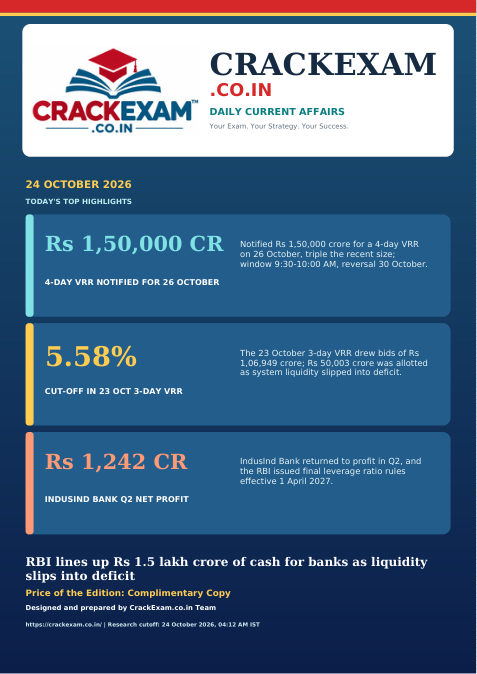
The RBI's 3-day Variable Rate Repo (VRR) auction on 23 October 2026, with a notified amount of Rs 50,000 crore, drew bids of Rs 1,06,949 crore. The RBI allotted Rs 50,003 crore at a cut-off rate of 5.58% and a weighted average rate of 5.60%, with 30.99% partial allotment to bidders at the cut-off rate. The auction reverses on 26 October 2026.
For Monday, 26 October 2026, the RBI announced a 4-day VRR auction of Rs 1,50,000 crore, three times the notified amount of recent auctions, with the bidding window from 9:30 AM to 10:00 AM and reversal on 30 October 2026.
The RBI's Money Market Operations release (position as on 22 October) shows net liquidity of minus Rs 31,254.95 crore when outstanding operations are included: the day's operations drained Rs 1,07,990 crore, partly offset by outstanding injections. The overnight money market weighted average rate was 5.66%; banks parked Rs 1,61,742 crore in the Standing Deposit Facility at 5.25% and borrowed Rs 3,746 crore under the Marginal Standing Facility at 5.75%.
Key facts- 3-day VRR 23 Oct: bids Rs 1,06,949 crore; allotted Rs 50,003 crore at 5.58% cut-off (WAR 5.60%; partial allotment 30.99%)
- 4-day VRR on 26 Oct: notified Rs 1,50,000 crore; window 9:30-10:00 AM; reversal 30 Oct
- Net liquidity incl. outstanding: minus Rs 31,254.95 crore (as on 22 Oct)
- Overnight WAR 5.66%; SDF Rs 1,61,742 crore; MSF Rs 3,746 crore
Exam takeaway: The tripling of the notified amount to Rs 1.5 lakh crore, with system liquidity in deficit, signals the RBI is willing to supply large durable support so that overnight rates stay close to the 5.50% repo rate.
Quick revision: 26 Oct: 4-day VRR of Rs 1.5 lakh crore; 23 Oct 3-day VRR drew Rs 1,06,949 crore of bids at 5.58% cut-off; system in deficit.
RBI press releases of 23 October 2026 (3-day VRR result, 4-day VRR notice, Money Market Operations) original sourceRBI & Regulatory Updates
RBI scales up liquidity support: Rs 1,50,000 crore 4-day VRR on 26 October after 3-day auction draws Rs 1.07 lakh crore
23 October 2026 | RBI press releases of 23 October 2026 (3-day VRR result, 4-day VRR notice, Money Market Operations)
The RBI's 3-day Variable Rate Repo (VRR) auction on 23 October 2026, with a notified amount of Rs 50,000 crore, drew bids of Rs 1,06,949 crore. The RBI allotted Rs 50,003 crore at a cut-off rate of 5.58% and a weighted average rate of 5.60%, with 30.99% partial allotment to bidders at the cut-off rate. The auction reverses on 26 October 2026.
For Monday, 26 October 2026, the RBI announced a 4-day VRR auction of Rs 1,50,000 crore, three times the notified amount of recent auctions, with the bidding window from 9:30 AM to 10:00 AM and reversal on 30 October 2026.
The RBI's Money Market Operations release (position as on 22 October) shows net liquidity of minus Rs 31,254.95 crore when outstanding operations are included: the day's operations drained Rs 1,07,990 crore, partly offset by outstanding injections. The overnight money market weighted average rate was 5.66%; banks parked Rs 1,61,742 crore in the Standing Deposit Facility at 5.25% and borrowed Rs 3,746 crore under the Marginal Standing Facility at 5.75%.
Key facts- 3-day VRR 23 Oct: bids Rs 1,06,949 crore; allotted Rs 50,003 crore at 5.58% cut-off (WAR 5.60%; partial allotment 30.99%)
- 4-day VRR on 26 Oct: notified Rs 1,50,000 crore; window 9:30-10:00 AM; reversal 30 Oct
- Net liquidity incl. outstanding: minus Rs 31,254.95 crore (as on 22 Oct)
- Overnight WAR 5.66%; SDF Rs 1,61,742 crore; MSF Rs 3,746 crore
Exam takeaway: The tripling of the notified amount to Rs 1.5 lakh crore, with system liquidity in deficit, signals the RBI is willing to supply large durable support so that overnight rates stay close to the 5.50% repo rate.
Quick revision: 26 Oct: 4-day VRR of Rs 1.5 lakh crore; 23 Oct 3-day VRR drew Rs 1,06,949 crore of bids at 5.58% cut-off; system in deficit.
RBI press releases of 23 October 2026 (3-day VRR result, 4-day VRR notice, Money Market Operations) original sourceRBI & Regulatory Updates
Leverage ratio: RBI issues final Basel III 2017 Standard directions, effective 1 April 2027
23 October 2026 | RBI press release of 23 October 2026; Economic Times and Mint reports
The RBI issued the final Leverage Ratio framework, 2017 Standard (Eleventh Amendment Directions, 2026), which comes into effect from 1 April 2027. The draft had been issued on 7 August 2026 for public comments; the RBI turned down banks' request for more time.
The minimum leverage ratio stays at 4% for Domestic Systemically Important Banks (D-SIBs) and 3.5% for other banks. For Indian branches of Global Systemically Important Banks (G-SIBs), the minimum is 3.5% plus the applicable G-SIB buffer.
Banks with an international presence, or with gross notional derivatives outstanding of Rs 25,000 crore and above (assessed group-wide), must use the Standardised Approach for measuring Counterparty Credit Risk exposures (SA-CCR) in the exposure measure; smaller banks may use either SA-CCR or the existing method. Banks cannot reduce exposures for collateral, guarantees or netting unless the framework allows it.
The leverage ratio is Tier 1 capital divided by the total exposure measure, computed at the end of every quarter (daily or monthly averages are allowed with RBI approval). The RBI may, at its discretion, temporarily exempt central bank reserves from the exposure measure.
Key facts- Final Leverage Ratio 2017 Standard: effective 1 April 2027
- Minimum: 4% for D-SIBs, 3.5% for others; G-SIB branches: 3.5% + G-SIB buffer
- SA-CCR mandatory for banks with international presence or derivatives of Rs 25,000 crore and above (group-wide)
- No reduction of exposures for collateral, guarantees or netting unless permitted
Exam takeaway: A leverage ratio is a non-risk-based backstop: it caps total balance-sheet and off-balance-sheet build-up regardless of how safe the assets look on a risk-weighted basis.
Quick revision: Leverage ratio final rules from 1 Apr 2027: 4% D-SIBs, 3.5% others; SA-CCR for large derivatives books.
RBI press release of 23 October 2026; Economic Times and Mint reports original sourceRBI & Regulatory Updates
Operational risk capital: RBI issues Second Amendment Directions on the Basel III standardised approach
23 October 2026 | RBI press release of 23 October 2026
The RBI issued the Second Amendment Directions on Minimum Capital Requirements for Operational Risk under the Basel III framework. The amendment updates the operational-risk capital directions in line with the standardised approach announced earlier.
The revised Basel III capital adequacy framework for banks, including the new Standardised Approach for operational risk, comes into effect from 1 April 2027, as announced in the Governor's Statement of 1 October 2025. The framework does not apply to Small Finance Banks, Payments Banks and Regional Rural Banks.
Under the standardised approach, operational-risk capital is based on the Business Indicator, a financial-statement-based proxy, replacing the older income-based approaches.
Key facts- Second Amendment Directions on Minimum Capital Requirements for Operational Risk
- New Standardised Approach effective 1 April 2027
- Not applicable to SFBs, Payments Banks and RRBs
- Capital based on the Business Indicator
Exam takeaway: The Business Indicator approach links operational-risk capital to the size of a bank's income, expense and interest items, so capital rises with the scale of operations.
Quick revision: Op-risk: Basel III standardised approach from 1 Apr 2027; SFBs/PBs/RRBs excluded.
RBI press release of 23 October 2026 original sourceRBI & Regulatory Updates
SEBI eases call-recording mandate for research analysts dealing with institutional clients
23 October 2026 | SEBI circular of 23 October 2026; Business Standard report
SEBI reviewed the requirement for research analysts and research entities to maintain call records of institutional clients, and decided that call recordings will not be mandatory for interactions with institutional investors.
The circular is effective from 8 November 2026. Other modes of keeping records of such interactions, in place of recordings, must be maintained for five years.
Key facts- Call recordings not mandatory for institutional-investor interactions
- Effective 8 November 2026
- Alternative records to be kept for five years
- Applies to research analysts and research entities
Exam takeaway: The change cuts compliance cost where clients are regulated institutions, while keeping a record trail for five years.
Quick revision: SEBI: no mandatory call records for institutional clients of research analysts from 8 Nov; 5-year alternative records.
SEBI circular of 23 October 2026; Business Standard report original sourceRBI & Regulatory Updates
Upper-layer NBFCs must list; CICs accessing public funds must register: RBI Governor
23 October 2026 | Business Standard report of the RBI Governor's address at the NDTV World Summit 2026, 23 October 2026
Speaking at the NDTV World Summit 2026, RBI Governor Sanjay Malhotra said NBFCs classified in the Upper Layer under scale-based regulation are required to list on stock exchanges, and that the RBI expects compliance.
He said Core Investment Companies (CICs) that access public funds, directly or indirectly, must register with the RBI. The remarks come in the context of the Tata Sons listing question (reported context).
Key facts- Upper-layer NBFCs must list on exchanges
- CICs accessing public funds, directly or indirectly, must register with the RBI
- Remarks at the NDTV World Summit 2026
- Reported in the context of the Tata Sons listing matter
Exam takeaway: Scale-based regulation puts bigger NBFCs in the Upper Layer with tighter rules; mandatory listing adds market discipline and disclosure.
Quick revision: Governor: upper-layer NBFCs must list; public-fund CICs must register.
Business Standard report of the RBI Governor's address at the NDTV World Summit 2026, 23 October 2026 original sourceBanking & Financial Industry News
IndusInd Bank Q2 FY27: net profit of Rs 1,242 crore against a year-ago loss; GNPA improves to 2.73%
23 October 2026 | The Hindu report on IndusInd Bank's September-quarter results, 23 October 2026
IndusInd Bank reported a net profit of Rs 1,242 crore for the September 2026 quarter, against a net loss of Rs 437 crore a year earlier; profit rose about 20% over the June quarter. Net interest income was Rs 4,569 crore and the net interest margin was 3.23%.
Asset quality improved: gross NPA ratio eased to 2.73% from 3.60% a year ago, and net NPA to 0.83% from 1.04%. The provision coverage ratio stood at 70%, and deposits grew 10% year on year.
The board appointed Priyanka Sinha as Additional Director (Non-Executive Independent) for four years, per the bank's filing reported by The Hindu.
Key facts- Net profit Rs 1,242 crore vs loss of Rs 437 crore a year ago; +20% quarter on quarter
- NII Rs 4,569 crore; NIM 3.23%
- GNPA 2.73% (3.60% a year ago); NNPA 0.83%; PCR 70%
- Deposits up 10% YoY; Priyanka Sinha appointed Additional Director (Independent)
Exam takeaway: A swing from loss to profit with falling NPA ratios shows the bank's clean-up and recovery progress after its derivatives-related setbacks.
Quick revision: IndusInd Q2: profit Rs 1,242 crore vs year-ago loss; GNPA 2.73%.
The Hindu report on IndusInd Bank's September-quarter results, 23 October 2026 original sourceBanking & Financial Industry News
SBI Funds Management Q2: net profit down 6% to Rs 701 crore; average AUM up 10%
23 October 2026 | The Hindu BusinessLine report, 23 October 2026
SBI Funds Management reported a 6% year-on-year fall in September-quarter net profit to Rs 701 crore from Rs 746 crore, as expenses rose 28%. Revenue grew 9% to Rs 1,193 crore.
Average assets under management rose 10% to Rs 13.14 lakh crore, with equity AUM at Rs 6.22 lakh crore and SIP inflows of Rs 3,900 crore in the quarter.
Key facts- Net profit Rs 701 crore, down 6% YoY (Rs 746 crore)
- Revenue up 9% to Rs 1,193 crore; expenses up 28%
- Average AUM Rs 13.14 lakh crore, up 10%; equity AUM Rs 6.22 lakh crore
- SIP inflows Rs 3,900 crore in the quarter
Exam takeaway: India's largest fund house shows the industry's AUM momentum continues even when quarterly profit dips on higher costs.
Quick revision: SBI Funds Q2: profit Rs 701 crore (-6%); AAUM Rs 13.14 lakh crore (+10%).
The Hindu BusinessLine report, 23 October 2026 original sourceBanking & Financial Industry News
C-DAC and Bank of India sign MoU to build a quantum ecosystem for financial innovation
23 October 2026 | PIB press release, 23 October 2026
The Centre for Development of Advanced Computing (C-DAC) and Bank of India signed a Memorandum of Understanding to build a quantum ecosystem for financial innovation.
The collaboration covers quantum computing applications in banking along with work on artificial intelligence, blockchain and cybersecurity.
Key facts- C-DAC and Bank of India signed the MoU on 23 October 2026
- Focus: quantum ecosystem for financial innovation
- Also covers AI, blockchain and cybersecurity
- Announced by the Press Information Bureau
Exam takeaway: C-DAC runs India's National Supercomputing Mission; a bank tie-up takes quantum research toward real financial use cases such as optimisation and security.
Quick revision: C-DAC + Bank of India: MoU for a quantum ecosystem in banking.
PIB press release, 23 October 2026 original sourceEconomy & Financial Awareness
FSDC 30th meeting: vigil on global risks; push on unclaimed assets and cyber security strategy
23 October 2026 | PIB press release, 23 October 2026
The Financial Stability and Development Council (FSDC), chaired by the Union Finance Minister, held its 30th meeting on 23 October 2026 and reviewed macro-financial stability amid geopolitical uncertainties, the AI boom and rising global bond yields.
The Council noted the Financial Sector Cyber Security Strategy, discussed digital onboarding for KYC, NRIs and FPIs, and the use of DPI, the Account Aggregator framework and the Unified Lending Interface for MSME credit.
Members pressed for faster refunds of unclaimed assets under the 'Your Money, Your Right' campaign, and the Council decided to meet more frequently.
Key facts- 30th FSDC meeting chaired by the Union Finance Minister
- Financial Sector Cyber Security Strategy noted
- Digital onboarding for KYC, NRIs and FPIs; DPI, Account Aggregator and ULI for MSME credit
- 'Your Money, Your Right' unclaimed-assets refund push; FSDC to meet more often
Exam takeaway: FSDC, set up in 2010, is the apex coordination body of financial sector regulators chaired by the Finance Minister.
Quick revision: FSDC 30th meeting: cyber strategy, unclaimed-asset refunds, more frequent meetings.
PIB press release, 23 October 2026 original sourceEconomy & Financial Awareness
RBI Bulletin October 2026: fresh lending rates down 93 bps against a 125 bps repo cut
23 October 2026 | RBI Bulletin, October 2026 (press release of 23 October 2026)
The October 2026 RBI Bulletin carries an article showing that, against a cumulative 125 basis points reduction in the policy repo rate, the weighted average lending rate (WALR) on fresh rupee loans fell 93 basis points between February 2025 and March 2026; of this, the interest-rate effect contributed 80 basis points and the composition effect 13 basis points.
The Bulletin's State of the Economy article notes that CPI inflation edged up in September 2026, and that exports grew in double digits in the first half of the year.
Key facts- Repo rate down 125 bps; WALR on fresh loans down 93 bps (Feb 2025 - Mar 2026)
- Interest effect 80 bps; composition effect 13 bps
- September 2026 CPI edged up
- H1 exports grew in double digits
Exam takeaway: Monetary transmission means policy rate changes reaching bank lending rates; the 93/125 bps split shows partial but substantial pass-through to fresh loans.
Quick revision: RBI Bulletin: WALR on fresh loans -93 bps vs repo -125 bps (Feb 2025-Mar 2026).
RBI Bulletin, October 2026 (press release of 23 October 2026) original sourceGovernment Schemes
No verified update for this section today.
Credit/NPA & Risk Management
Delhi Police busts mule-account network with bank insiders: Rs 7.36 crore across 99 complaints
23 October 2026 | PTI report, 23 October 2026
Delhi Police uncovered 37 suspected mule bank accounts - 17 at the Saraswati Vihar branch and 20 at the Tri Nagar branch of a private bank - that received Rs 7.36 crore linked to 99 cyber fraud complaints across India. Six people were arrested, including a branch manager.
Accounts were opened with forged signatures and KYC documents collected from daily-wage labourers on the pretext of loan approvals, without the holders being present. Part of the proceeds was converted into cryptocurrency. The FIR was registered on 17 June and the arrests followed investigation; police recovered laptops, phones, SIM cards, cheque books and debit cards.
Key facts- 37 mule accounts; Rs 7.36 crore; 99 cyber fraud complaints
- Six arrested, including a bank branch manager
- Forged KYC from daily-wage labourers; holders never visited branches
- Part of proceeds converted to cryptocurrency
Exam takeaway: Mule accounts are the cash-out layer of cyber fraud; the case shows why in-person KYC verification and branch-level controls matter.
Quick revision: Delhi Police: 37 mule accounts, Rs 7.36 crore, 99 complaints; branch manager among six arrested.
PTI report, 23 October 2026 original sourceNational, International & Appointments
IndusInd Bank appoints Priyanka Sinha as Additional Director (Independent)
23 October 2026 | IndusInd Bank board decision reported by The Hindu, 23 October 2026
The board of IndusInd Bank appointed Priyanka Sinha as an Additional Director in the Non-Executive Independent category for a term of four years, the bank informed exchanges alongside its quarterly results.
Key facts- Priyanka Sinha appointed Additional Director (Non-Executive Independent)
- Term of four years
- Announced with the September-quarter results
- Appointment reported 23 October 2026
Exam takeaway: Independent directors strengthen board oversight, a focus area for the bank after its governance lapses.
Quick revision: IndusInd board: Priyanka Sinha joins as independent director for four years.
IndusInd Bank board decision reported by The Hindu, 23 October 2026 original sourceNational, International & Appointments
Fed and ECB expected to hold rates at next week's meetings: reports
23 October 2026 | Market reports of 23 October 2026 (WSJ, OANDA, CNBC)
Market reports expect both the US Federal Reserve and the European Central Bank to hold policy rates at their meetings in the coming week.
For the Fed, the US government shutdown has limited official data, and for the ECB, inflation near target supports a pause, the reports say. These are market expectations, not central-bank statements.
Key facts- Fed and ECB meet in the coming week
- Both widely expected to hold rates, per market reports
- Fed decision clouded by the US data shutdown
- ECB pause supported by inflation near target
Exam takeaway: Global rate expectations feed into FPI flows, the rupee and G-sec yields, so exam questions often test which central banks are pausing.
Quick revision: Fed and ECB meetings next week: both expected to hold (market reports).
Market reports of 23 October 2026 (WSJ, OANDA, CNBC) original sourceKnowledge Article
What is SA-CCR, and why did the RBI set a Rs 25,000 crore trigger?
RBI press release of 23 October 2026 (final Leverage Ratio 2017 Standard) and the Economic Times report
SA-CCR, the Standardised Approach for measuring Counterparty Credit Risk exposures, sizes a derivatives exposure as replacement cost plus potential future exposure, scaled by a supervisory factor of 1.4. It replaced the older Current Exposure Method in the Basel framework.
In the final leverage ratio rules, banks with an international presence, or with gross notional derivatives outstanding of Rs 25,000 crore and above (assessed group-wide), must use SA-CCR in the leverage exposure measure; smaller banks may use either method.
Why it matters: the leverage ratio counts exposures gross, with no benefit for collateral, guarantees or netting, so the measurement method decides how much Tier 1 capital a derivatives book consumes.
RBI press release of 23 October 2026 (final Leverage Ratio 2017 Standard) and the Economic Times report original sourcePractical Banking Case Study
Reading an auction result: the 23 October 3-day VRR
Worked example from the RBI press release of 23 October 2026 (VRR result); ratios computed here.
Notified amount Rs 50,000 crore; bids received Rs 1,06,949 crore; amount allotted Rs 50,003 crore; cut-off rate 5.58%; weighted average rate 5.60%; partial allotment of 30.99% of bids at the cut-off rate.
Working- Bid-cover ratio = 1,06,949 / 50,000 = 2.14 times - banks wanted over twice the cash on offer.
- Cut-off vs corridor: 5.58% sits 8 bps above the 5.50% repo rate and 17 bps below the 5.75% MSF rate, inside the corridor.
- Partial allotment: a bank bidding at the 5.58% cut-off got only 30.99% of its bid filled; bids below the cut-off were filled in full (uniform-price auction).
- Allotment over the notified amount = 50,003 - 50,000 = Rs 3 crore.
Exam takeaway: When the bid-cover ratio stays above 2 and the cut-off rises toward the MSF rate, liquidity demand is strong - which is what the Rs 1,50,000 crore 4-day VRR on 26 October responds to.
Today's Scheme
Pradhan Mantri Jeevan Jyoti Bima Yojana (PMJJBY): features and current terms
Department of Financial Services, Ministry of Finance
PMJJBY is a one-year life insurance scheme, renewable from year to year, offering life cover of Rs 2 lakh for death due to any reason.
Premium: Rs 436 per year, auto-debited from the subscriber's bank account. Risk cover period: 1 June to 31 May.
The scheme is offered by LIC and other life insurers willing to offer the product on similar terms, with tie-ups with banks. Cumulative enrolment was 23.12 crore as on 28 February 2025 (DFS figures).
Key facts- Life cover Rs 2 lakh for death due to any reason
- Annual premium Rs 436, auto-debit from the bank account
- Risk cover period 1 June to 31 May, renewable yearly
- Cumulative enrolment 23.12 crore (as on 28.02.2025)
- Eligibility: age 18 to 50 years with a bank account
Exam takeaway: Keep PMJJBY apart from PMSBY: PMJJBY is life insurance (Rs 2 lakh cover, Rs 436 premium), while PMSBY is accident insurance (Rs 2 lakh cover, Rs 20 premium).
Department of Financial Services, Ministry of Finance original sourceBank Promotion Exam Corner
4-day VRR 26 October: notified Rs 1,50,000 crore (window 9:30-10:00 AM, reversal 30 October); 3-day VRR 23 October: bids Rs 1,06,949 crore, allotted Rs 50,003 crore at 5.58%.
Money market, 22 October: overnight weighted average rate 5.66%; SDF Rs 1,61,742 crore at 5.25%; MSF Rs 3,746 crore at 5.75%; net liquidity incl. outstanding minus Rs 31,254.95 crore.
Final leverage ratio rules from 1 April 2027: 4% minimum for D-SIBs, 3.5% for others; SA-CCR mandatory for large derivatives books.
IndusInd Bank Q2: net profit Rs 1,242 crore vs a year-ago loss; GNPA 2.73%.
Daily MCQ Challenge
1. What is the notified amount of the RBI's 4-day VRR auction scheduled for 26 October 2026?
A. Rs 1,50,000 crore
B. Rs 50,000 crore
C. Rs 75,000 crore
D. Rs 1,00,000 crore
Answer: A. The RBI announced a 4-day VRR of Rs 1,50,000 crore for 26 October 2026, with reversal on 30 October.
2. From which date do the RBI's final Leverage Ratio 2017 Standard directions take effect?
A. 1 January 2027
B. 1 October 2026
C. 1 April 2026
D. 1 April 2027
Answer: D. The final Leverage Ratio framework (Eleventh Amendment Directions) is effective 1 April 2027.
3. Under the amended directions, from when does the new Standardised Approach for operational-risk capital apply?
A. 1 April 2027
B. 1 October 2026
C. 1 January 2026
D. 1 April 2026
Answer: A. The revised Basel III operational-risk framework is effective 1 April 2027.
4. SEBI's relaxation on call records for research analysts dealing with institutional clients takes effect from:
A. 23 October 2026
B. 1 January 2027
C. 8 November 2026
D. 1 April 2027
Answer: C. The circular is effective from 8 November 2026.
5. According to the RBI Governor at the NDTV World Summit 2026, NBFCs in which layer must list on stock exchanges?
A. Base Layer
B. Middle Layer
C. Upper Layer
D. Top Layer
Answer: C. NBFCs classified in the Upper Layer under scale-based regulation are required to list.
Revision: recent days
21 October 2026: Earlier edition: the call rate was 5.66% on 19 October against the 5.75% MSF rate; the DFS campaign runs 21 October to 31 December.
22 October 2026: Earlier edition: the 21 October overnight VRR cleared at 5.52% with bids of Rs 93,241 crore; the 22 October auction drew Rs 1,62,354 crore at a 5.54% cut-off.
23 October 2026: Earlier edition: the 22 October overnight VRR drew bids of Rs 1,62,354 crore at a 5.54% cut-off; the 23 October 3-day VRR drew Rs 1,06,949 crore at 5.58%.
Sources and publication information
The VRR, money market, leverage ratio, operational-risk and Bulletin items are from RBI press releases of 23 October 2026. The SEBI item is from the SEBI circular and Business Standard. The Governor's remarks are from Business Standard (NDTV World Summit). IndusInd Bank and the Priyanka Sinha appointment are from The Hindu, SBI Funds from The Hindu BusinessLine, the FSDC and C-DAC items from PIB, the Fed/ECB item from market reports (WSJ/OANDA/CNBC), and the mule-account case from PTI via Moneycontrol.