Monetary Policy Rates
As on 23 October 2026
| Rate | Current | Effective from |
|---|
| Policy Repo Rate | 5.50% | w.e.f. 7 October 2026 |
| Standing Deposit Facility (SDF) | 5.25% | w.e.f. 7 October 2026 |
| Marginal Standing Facility (MSF) | 5.75% | w.e.f. 7 October 2026 |
| Bank Rate | 5.75% | w.e.f. 7 October 2026 |
| Cash Reserve Ratio (CRR) | 3.00% | fortnight from 29 Nov 2025 |
| Statutory Liquidity Ratio (SLR) | 18.00% | RBI CRR & SLR Directions, 2025 |
Repo, SDF, MSF and Bank Rate unchanged since the 7 October MPC resolution.
CRR and SLR checked against the RBI homepage and official reserve-ratio requirements.
Sources: RBI current rates | RBI MPC resolution | RBI CRR change | RBI reserve ratios
Cover Story
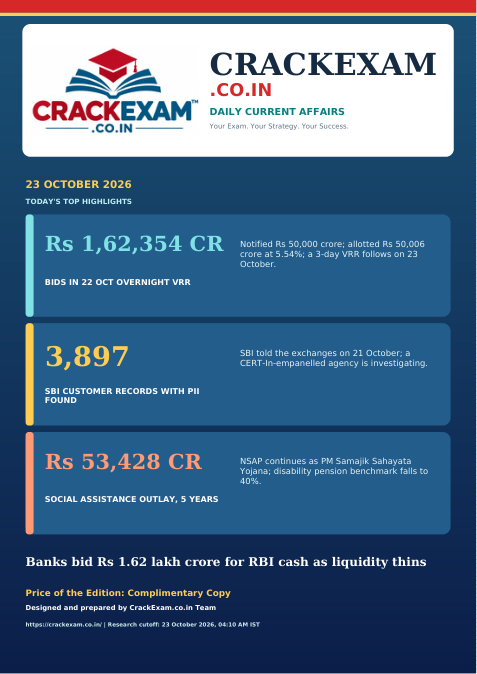
Banks bid Rs 1.62 lakh crore for RBI cash as liquidity thins
22 October 2026 | RBI press releases of 22 October 2026 (VRR result, VRR notice, Money Market Operations); Moneycontrol for market commentary
The RBI's overnight Variable Rate Repo (VRR) auction on 22 October 2026 had a notified amount of Rs 50,000 crore. Banks bid Rs 1,62,354 crore, and the RBI allotted Rs 50,006 crore at a cut-off rate of 5.54% and a weighted average rate of 5.55%. Bids at the cut-off rate were allotted 3.2%.
For 23 October the RBI announced a 3-day VRR auction of Rs 50,000 crore, with the window from 9:30 AM to 10:00 AM and reversal on Monday, 26 October 2026.
RBI's Money Market Operations table shows net liquidity of minus Rs 541.95 crore after the day's operations, against the 5.50% repo rate and 5.75% MSF rate; Moneycontrol reports the system surplus fell to Rs 541.95 crore, the lowest since 29 June, and cites GST outflows, an SDL auction, forex intervention and currency leakage as causes (market participants' views, not RBI statements).
Key facts- Overnight VRR 22 Oct: bids Rs 1,62,354 crore; allotted Rs 50,006 crore
- Cut-off 5.54%, weighted average 5.55%, partial allotment 3.2%
- 3-day VRR on 23 Oct: Rs 50,000 crore, reversal 26 Oct 2026
- Net liquidity: surplus of Rs 541.95 crore (RBI MMO table)
Exam takeaway: A bid-cover ratio of 3.25 times (162,354 / 50,000) shows banks wanted far more cash than the RBI offered. The cut-off (5.54%) sits 4 bps above the repo rate and 21 bps below the MSF rate.
Quick revision: VRR 22 Oct: bids Rs 1.62 lakh crore, allotted Rs 50,006 crore at 5.54%; 3-day VRR Rs 50,000 crore on 23 Oct.
RBI press releases of 22 October 2026 (VRR result, VRR notice, Money Market Operations); Moneycontrol for market commentary original sourceRBI & Regulatory Updates
RBI overnight VRR draws Rs 1.62 lakh crore of bids; a 3-day VRR is set for 23 October
22 October 2026 | RBI press releases of 22 October 2026 (VRR result, VRR notice, Money Market Operations); Moneycontrol for market commentary
The RBI's overnight Variable Rate Repo (VRR) auction on 22 October 2026 had a notified amount of Rs 50,000 crore. Banks bid Rs 1,62,354 crore, and the RBI allotted Rs 50,006 crore at a cut-off rate of 5.54% and a weighted average rate of 5.55%. Bids at the cut-off rate were allotted 3.2%.
For 23 October the RBI announced a 3-day VRR auction of Rs 50,000 crore, with the window from 9:30 AM to 10:00 AM and reversal on Monday, 26 October 2026.
RBI's Money Market Operations table shows net liquidity of minus Rs 541.95 crore after the day's operations, against the 5.50% repo rate and 5.75% MSF rate; Moneycontrol reports the system surplus fell to Rs 541.95 crore, the lowest since 29 June, and cites GST outflows, an SDL auction, forex intervention and currency leakage as causes (market participants' views, not RBI statements).
Key facts- Overnight VRR 22 Oct: bids Rs 1,62,354 crore; allotted Rs 50,006 crore
- Cut-off 5.54%, weighted average 5.55%, partial allotment 3.2%
- 3-day VRR on 23 Oct: Rs 50,000 crore, reversal 26 Oct 2026
- Net liquidity: surplus of Rs 541.95 crore (RBI MMO table)
Exam takeaway: A bid-cover ratio of 3.25 times (162,354 / 50,000) shows banks wanted far more cash than the RBI offered. The cut-off (5.54%) sits 4 bps above the repo rate and 21 bps below the MSF rate.
Quick revision: VRR 22 Oct: bids Rs 1.62 lakh crore, allotted Rs 50,006 crore at 5.54%; 3-day VRR Rs 50,000 crore on 23 Oct.
RBI press releases of 22 October 2026 (VRR result, VRR notice, Money Market Operations); Moneycontrol for market commentary original sourceRBI & Regulatory Updates
RBI tells banks and payment firms to treat tech environments as compromised until forensically cleared, ET reports
19 October 2026 (advisory); reported 22-23 October 2026 | The Economic Times (Saloni Shukla), last updated 23 October 2026 12:37 AM IST; the RBI advisory itself was not read
The Economic Times reports that the RBI issued an advisory on 19 October 2026 to banks, payment system operators and other regulated entities. After any exposure of credentials or confirmed unauthorised access, they must treat the technology environment as compromised until it is forensically cleared.
The advisory asks entities to remove management and administrative interfaces from public internet access, enforce multi-factor authentication for administrative access, restrict access to cloud and backend systems on a least-privilege basis, and audit source code, repositories, configuration files and cloud storage for exposed credentials, which are to be rotated and purged immediately.
Entities should also keep an inventory of APIs, shut dormant, deprecated and test APIs and accounts, strengthen real-time API monitoring for bursts of automated requests and bulk data extraction, and report incidents to the RBI central office and the regional office. The advisory annexes a CERT-In warning of 15 October about attackers using autonomous AI tools. ET says the advisory was seen by it; the RBI had not published it as a press release.
Key facts- Advisory dated 19 October 2026, annexing a CERT-In warning of 15 October
- Treat the environment as compromised until forensically cleared
- Multi-factor authentication for admin access; no admin interfaces on the public internet
- Keep an API inventory and shut dormant or test APIs; report incidents to the RBI
Exam takeaway: CERT-In is the national agency for cyber incidents. Know the controls: MFA, least privilege, API inventory, credential rotation and incident reporting.
Quick revision: RBI advisory (19 Oct, per ET): treat tech environment as compromised until forensically cleared; MFA for admin access; API inventory.
The Economic Times (Saloni Shukla), last updated 23 October 2026 12:37 AM IST; the RBI advisory itself was not read original sourceRBI & Regulatory Updates
RBI extends directions on The Suri Friends' Union Co-operative Bank, West Bengal, to 22 January 2027
22 October 2026 | RBI press release 2026-2027/1367, 22 October 2026
The RBI extended its directions under Section 35A read with Section 56 of the Banking Regulation Act, 1949 to The Suri Friends' Union Co-operative Bank Ltd., Suri, West Bengal, by three months, from close of business on 22 October 2026 to close of business on 22 January 2027, subject to review.
The directions were first issued on 21 July 2022 for six months, up to 22 January 2023, and were last extended up to 22 October 2026 by a directive dated 14 July 2026. The RBI said the extension should not by itself be read as meaning it is satisfied with the bank's financial position, and other terms of the directive stay unchanged.
Key facts- Section 35A with Section 56 of the Banking Regulation Act, 1949
- Extension: 22 October 2026 to 22 January 2027 (three months), subject to review
- Original directive: 21 July 2022
- Bank: Suri, West Bengal
Exam takeaway: Section 35A gives the RBI power to give directions to banks; Section 56 applies it to co-operative banks. An extension is not a licence cancellation.
Quick revision: Suri Friends' Union Co-op Bank (WB): 35A+56 directions extended to 22 Jan 2027 (3 months).
RBI press release 2026-2027/1367, 22 October 2026 original sourceRBI & Regulatory Updates
SEBI warns investors against stock tips in invitation-only WhatsApp groups
22 October 2026 | SEBI press release of 22 October 2026, as reported by Moneycontrol and Business Standard (the SEBI page text was not fully readable)
SEBI cautioned investors against unregistered persons who offer buy and sell calls through invitation-only WhatsApp groups, often using overseas numbers and presenting themselves as market experts under the name of free investor education.
Moneycontrol reports that some members work with the operators to post false profit claims and praise, which it calls astroturfing, to make the calls look genuine. After action against a group, members may get a message, usually from a new number, saying the earlier group was banned for platform risk-control reasons, and are invited to a new group.
SEBI advised investors not to join such groups, not to trust profit claims, trade confirmations or praise messages, not to transfer money to suggested platforms or share trading account details, and to deal only with SEBI-registered intermediaries (Business Standard).
Key facts- Target: unregistered stock-tip groups on WhatsApp, often with overseas numbers
- Tactic: planted testimonials (astroturfing) and re-invites from new numbers
- Advice: deal only with SEBI-registered intermediaries
- Do not share trading account details or transfer money to suggested platforms
Exam takeaway: Astroturfing means creating fake grassroots support. Only SEBI-registered intermediaries may give investment advice or research.
Quick revision: SEBI (22 Oct): beware invitation-only WhatsApp stock-tip groups; planted testimonials; use registered intermediaries only.
SEBI press release of 22 October 2026, as reported by Moneycontrol and Business Standard (the SEBI page text was not fully readable) original sourceRBI & Regulatory Updates
SEBI allows margin relief on subsequent positions after early pay-in of securities, Business Standard reports
22 October 2026 | Business Standard (Our Bureau), 22 October 2026, on a SEBI circular of the same date; the circular text was not fully read
Business Standard reports that SEBI said on 22 October 2026 that clearing corporations will not collect margins from trading and clearing members on clients' subsequent buy or sell positions in the cash segment, up to the value of securities for which early pay-in (EPI) has been successfully accepted.
The aim is margin relief for clients who have a net sell obligation in a settlement and have completed the EPI process through the clearing corporation. The SEBI circular is titled Margin Waiver on Subsequent Buy/Sell Transactions Post Early Pay-In (EPI) in Cash Segment.
Key facts- SEBI circular of 22 October 2026: margin waiver post early pay-in (cash segment)
- Waiver applies up to the value of securities for which EPI is accepted
- Benefit: clients with a net sell obligation who completed EPI
- Clearing corporations will not collect margins from members on those positions
Exam takeaway: Early pay-in means delivering securities to the clearing corporation before the normal pay-in time. The relief lowers the margin burden on the client's later trades.
Quick revision: SEBI (22 Oct): no margin on later cash-segment trades up to the value of securities with accepted early pay-in.
Business Standard (Our Bureau), 22 October 2026, on a SEBI circular of the same date; the circular text was not fully read original sourceBanking & Financial Industry News
Indian Bank raises 555-day and 777-day special deposit rates by 15 bps from 23 October
22 October 2026 (effective 23 October) | Business Standard (Anjali Kumari), 22 October 2026
Indian Bank raised the interest rates on its special term deposit schemes by 15 basis points each, effective 23 October 2026, Business Standard reports.
The 555-day Ind Grow scheme rate goes to 6.80% from 6.65%, and the 777-day Ind Prosper scheme rate goes to 6.75% from 6.60%. The report links the move to the RBI's October repo rate increase of 25 bps to 5.50%.
Key facts- Effective 23 October 2026: +15 bps on both special deposits
- 555-day Ind Grow: 6.65% to 6.80%
- 777-day Ind Prosper: 6.60% to 6.75%
- Context: repo rate raised by 25 bps to 5.50% in October
Exam takeaway: Banks reprice deposits after a repo hike to protect margins. 100 bps equals 1 percentage point, so 15 bps is 0.15 percentage point.
Quick revision: Indian Bank (from 23 Oct): Ind Grow 555 days 6.80%; Ind Prosper 777 days 6.75%; each +15 bps.
Business Standard (Anjali Kumari), 22 October 2026 original sourceBanking & Financial Industry News
SBI tells exchanges 3,897 customer records with personal data were found among about 3.75 lakh posted on the dark web
21 October 2026 (filing); reported 21-22 October 2026 | The Hindu (Lalatendu Mishra), 21 and 22 October 2026, reporting SBI's stock exchange filing; the filing itself was not read
The Hindu reports that State Bank of India told the stock exchanges on 21 October 2026 about an incident involving the loss of certain data. On 16 October 2026 the bank had received communications from its Threat Intelligence Service Provider, the Defence Cyber Agency and CERT-In about a suspected exposure of customer data on the dark web.
In its filing SBI said that, in a preliminary analysis of about 3,75,000 records available on the dark web, 3,897 customer records containing personally identifiable information were identified. The exposed fields included registered mobile numbers, dates of birth, names, gender, email and residential addresses, branch and CIF identifiers and lead IDs. SBI said a detailed investigation is needed to establish the authenticity, source and extent of the exposure, and that a CERT-In-empanelled agency was engaged.
SBI said the incident has no material impact on core business operations, financial performance or business continuity, and that customer balances are safe (India Today and Mint quote the bank). The claim by the group that posted the data, which says it holds 3,75,000 records and 2,722 PDF files, has not been confirmed by SBI. Cybersecurity researchers quoted by The Hindu warn that such data feeds more convincing fraud calls.
Key facts- SBI exchange filing: 21 October 2026; alert received 16 October
- Preliminary count: 3,897 PII records among about 3,75,000 records on the dark web
- Investigation by a CERT-In-empanelled agency; authenticity and extent still to be established
- SBI says core operations and customer balances are not affected
Exam takeaway: A disclosure to stock exchanges under SEBI listing norms is how a listed bank reports a material incident. CERT-In is the national cyber agency; a CIF is the customer information file identifier.
Quick revision: SBI (21 Oct filing): 3,897 customer records with PII among ~3.75 lakh posted on dark web; CERT-In-empanelled agency probing.
The Hindu (Lalatendu Mishra), 21 and 22 October 2026, reporting SBI's stock exchange filing; the filing itself was not read original sourceEconomy & Financial Awareness
Final redemption of Sovereign Gold Bond 2018-19 Series-II on 23 October: Rs 14,425 per unit
22 October 2026 | RBI press release 2026-2027/1369, 22 October 2026
The RBI announced the redemption price for the final redemption of Sovereign Gold Bond (SGB) 2018-19 Series-II, due on 23 October 2026, at Rs 14,425 per unit.
The bond was issued on 23 October 2018 and is repayable on the expiry of eight years from the issue date. The redemption price is the simple average of the closing price of gold of 999 purity of the previous three business days, as published by the India Bullion and Jewellers Association Ltd (IBJA). For this redemption the three days are 19, 21 and 22 October 2026.
Key facts- Redemption price: Rs 14,425 per unit, due 23 October 2026
- Issue date 23 October 2018; maturity after eight years
- Price = simple average of IBJA 999-purity gold close for the previous three business days
- Averaging days: 19, 21 and 22 October 2026
Exam takeaway: The SGB price follows the IBJA gold price, not a fixed rate. Keep the tenor (eight years) and the three-day averaging method.
Quick revision: SGB 2018-19 Series-II: final redemption 23 Oct 2026 at Rs 14,425 (IBJA 3-day average).
RBI press release 2026-2027/1369, 22 October 2026 original sourceGovernment Schemes
Cabinet renews National Social Assistance Programme as Pradhan Mantri Samajik Sahayata Yojana; disability pension widened
14 October 2026 (approval); PIB release 22 October 2026 | PIB, Ministry of Rural Development, 22 October 2026
PIB reports that on 14 October 2026 the Union Cabinet approved continuing the National Social Assistance Programme for five years, 2026-27 to 2030-31, with an outlay of Rs 53,428 crore. The programme is renamed the Pradhan Mantri Samajik Sahayata Yojana, and its four sub-schemes are renamed too: the old age pension becomes the Pradhan Mantri Vridhavastha Pension Yojana, the widow pension the Pradhan Mantri Vidhawa Pension Yojana, the disability pension the Pradhan Mantri Divyangjan Pension Yojana, and the family benefit the Pradhan Mantri Parivar Labh Yojana.
The old age, widow and family benefit schemes continue in their existing form. The disability pension is revised: it now uses the 40 per cent benchmark disability of the Rights of Persons with Disabilities Act 2016 in place of 80 per cent, and the minimum age of 18 years is removed, so eligibility runs from birth.
Central assistance under the disability pension rises to Rs 375 a month for ages 0-79 and Rs 625 a month at 80 years and above, from Rs 300 and Rs 500 earlier. Disability pension beneficiaries rise from 8.33 lakh to 27.48 lakh, and the programme's coverage is put at 3.20 crore beneficiaries across all 36 States and Union Territories.
Key facts- Outlay Rs 53,428 crore for 2026-27 to 2030-31
- New name: Pradhan Mantri Samajik Sahayata Yojana
- Disability benchmark 40% (earlier 80%); minimum age of 18 removed
- Disability pension: Rs 375 (ages 0-79) and Rs 625 (80+); beneficiaries 8.33 lakh to 27.48 lakh
Exam takeaway: NSAP was launched on 15 August 1995 and gives effect to Article 41 of the Constitution (public assistance for unemployment, old age, sickness and disablement). It is a centrally sponsored scheme with 100% central assistance.
Quick revision: NSAP renewed as PM Samajik Sahayata Yojana: Rs 53,428 crore, 2026-27 to 2030-31; disability benchmark 40%; Rs 375 / Rs 625.
PIB, Ministry of Rural Development, 22 October 2026 original sourceCredit/NPA & Risk Management
Nippon Life India AMC gets in-principle SEBI nod to settle Yes Bank AT-1 bond case for Rs 96.76 crore, Reuters reports
22 October 2026 | Reuters via The Hindu BusinessLine, updated 22 October 2026, 4:53 PM; the SEBI order was not read
Nippon Life India Asset Management said on 22 October 2026 that it received in-principle approval from the markets regulator to settle a dispute over alleged fraudulent investments in Yes Bank additional tier-1 (AT-1) bonds, after paying Rs 96.76 crore. It paid the settlement charges in the September quarter and is waiting for a formal settlement order.
Reuters reports that SEBI had alleged that between 2016 and 2019 Reliance Mutual Fund, now Nippon Life India Mutual Fund, invested Rs 2,150 crore in Yes Bank AT-1 bonds in return for Anil Ambani-backed companies receiving loans. Anil Ambani sold Reliance Mutual Fund to Nippon Life in October 2019, and the AT-1 investment became worthless after Yes Bank's 2020 collapse, the report says. The company said any money recovered after the court ruling would go to investors in the relevant schemes.
Key facts- Settlement amount: Rs 96.76 crore; in-principle approval, formal order awaited
- Alleged AT-1 investment: Rs 2,150 crore, 2016-2019
- Instrument: Yes Bank additional tier-1 (AT-1) bonds
- Reliance Mutual Fund sold to Nippon Life in October 2019
Exam takeaway: AT-1 bonds are perpetual, loss-absorbing capital instruments that banks issue to meet Basel III tier-1 capital; they can be written down. Settlement lets a party resolve a SEBI case without admitting or denying findings.
Quick revision: Nippon Life India AMC: in-principle SEBI nod to settle Yes Bank AT-1 case for Rs 96.76 crore (Reuters, 22 Oct).
Reuters via The Hindu BusinessLine, updated 22 October 2026, 4:53 PM; the SEBI order was not read original sourceNational, International & Appointments
No verified update for this section today.
Knowledge Article
How the Sovereign Gold Bond redemption price is set
RBI press release 2026-2027/1369, 22 October 2026
An SGB is repayable on the expiry of eight years from its issue date. The tranche issued on 23 October 2018 therefore has its final redemption on 23 October 2026.
The redemption price is not fixed in advance. It is the simple average of the closing price of gold of 999 purity of the previous three business days, as published by the India Bullion and Jewellers Association Ltd (IBJA).
For the 23 October 2026 redemption the RBI used 19, 21 and 22 October and announced Rs 14,425 per unit.
Key facts- Tenor: eight years from issue
- Price: simple average of IBJA 999-purity gold for the previous three business days
- 23 October 2026 redemption: Rs 14,425 per unit
RBI press release 2026-2027/1369, 22 October 2026 original sourcePractical Banking Case Study
Reading an auction result: the 22 October overnight VRR
Worked example from the RBI press release of 22 October 2026 (VRR result); ratios computed here.
Notified amount Rs 50,000 crore; bids received Rs 1,62,354 crore; amount allotted Rs 50,006 crore; cut-off rate 5.54%; weighted average rate 5.55%; partial allotment of 3.2% of bids at the cut-off rate.
Working- Bid-cover ratio = 1,62,354 / 50,000 = 3.25 times.
- Share of bids allotted = 50,006 / 1,62,354 = 30.8%.
- Allotment over the notified amount = 50,006 - 50,000 = Rs 6 crore.
- Spread of the cut-off over the repo rate = 5.54% - 5.50% = 4 bps; the MSF rate (5.75%) is 21 bps above the cut-off.
Exam takeaway: A bid-cover ratio of 3.25 times shows banks needed far more cash than the RBI offered. The cut-off rate has risen from 5.52% (21 October) to 5.54%, still between repo (5.50%) and MSF (5.75%).
Today's Scheme
Atal Pension Yojana (APY): features and current terms
Department of Financial Services, Ministry of Finance
APY encourages workers in the unorganised sector to save voluntarily for retirement. It gives a defined pension that depends on the contribution and its period.
Benefit: a fixed minimum pension of Rs 1,000, Rs 2,000, Rs 3,000, Rs 4,000 or Rs 5,000 a month at age 60, depending on the contribution, which is based on the age of joining. The minimum joining age is 18 and the maximum is 40, so contributions run for 20 years or more.
The Central Government guarantees the minimum pension: if the corpus earns less than estimated, the Centre funds the gap, and if returns are higher, subscribers get enhanced benefits. Contributions can be monthly, quarterly or half-yearly, and voluntary exit is allowed on certain conditions.
Key facts- Minimum guaranteed pension Rs 1,000 to Rs 5,000 a month at age 60
- Joining age 18 to 40; at least 20 years of contribution
- Government guarantees the minimum pension
Exam takeaway: Keep the three Jan Suraksha schemes apart from APY: PMSBY and PMJJBY are insurance; APY is a pension scheme with a guaranteed minimum pension from age 60.
Department of Financial Services, Ministry of Finance original sourceBank Promotion Exam Corner
Overnight VRR 22 October: bids Rs 1,62,354 crore, allotted Rs 50,006 crore at 5.54% (weighted average 5.55%); 3-day VRR of Rs 50,000 crore on 23 October, reversal 26 October.
Money market, 21 October: overnight segment 5.64%; call money 5.65%; SDF Rs 1,25,597 crore at 5.25%; MSF Rs 2,613 crore at 5.75%.
SBI (21 October filing): 3,897 customer records with PII among about 3.75 lakh on the dark web; CERT-In-empanelled agency engaged.
RBI advisory of 19 October (per ET): treat tech environment as compromised until forensically cleared; MFA; API inventory.
SGB 2018-19 Series-II: final redemption on 23 October at Rs 14,425 per unit. G-sec auction on 23 October: Rs 33,000 crore (6.53% GS 2031 Rs 19,000 crore; 7.71% GS 2066 Rs 14,000 crore).
NSAP is now PM Samajik Sahayata Yojana: Rs 53,428 crore, 2026-27 to 2030-31; disability benchmark 40%; Rs 375 / Rs 625 a month.
Daily MCQ Challenge
1. In the overnight VRR auction of 22 October 2026, the amount of bids received was:
A. Rs 93,241 crore
B. Rs 1,62,354 crore
C. Rs 50,006 crore
D. Rs 1,00,014 crore
Answer: B. Banks bid Rs 1,62,354 crore against a notified Rs 50,000 crore.
2. According to The Economic Times, the RBI advisory on technology environments was issued on:
A. 15 October 2026
B. 22 October 2026
C. 19 October 2026
D. 7 October 2026
Answer: C. ET reports the advisory was issued on 19 October 2026.
3. The RBI extended its directions on The Suri Friends' Union Co-operative Bank up to:
A. 22 October 2027
B. 22 January 2027
C. 21 July 2027
D. 22 April 2027
Answer: B. Three months from 22 October 2026 to 22 January 2027.
4. SEBI's 22 October 2026 caution concerns stock tips offered through:
A. Registered research analysts
B. Stock exchange apps
C. Newspaper columns
D. Invitation-only WhatsApp groups
Answer: D. SEBI warned about unregistered persons running invitation-only WhatsApp groups.
5. SEBI's 22 October 2026 circular gives margin relief after:
A. Early pay-in (EPI) of securities
B. IPO allotment
C. Corporate bond issue
D. Delisting of a stock
Answer: A. The circular covers margin waiver post early pay-in in the cash segment.
Revision: recent days
20 October 2026: Earlier edition: the 19 October 7-day VRR allotted Rs 1,00,014 crore at a 5.51% cut-off; the 21 October overnight VRR cleared at 5.52%.
21 October 2026: Earlier edition: the call rate was 5.66% on 19 October against the 5.75% MSF rate; the DFS campaign runs 21 October to 31 December.
22 October 2026: Earlier edition: the 21 October overnight VRR cleared at 5.52% with bids of Rs 93,241 crore; the 22 October auction drew Rs 1,62,354 crore at a 5.54% cut-off.
Sources and publication information
The VRR, Suri bank and SGB items are from RBI press releases of 22 October 2026. The technology advisory item is from The Economic Times (the advisory was not read). The SEBI items are from Moneycontrol and Business Standard reports on SEBI releases. The SBI item is from The Hindu reports on SBI's exchange filing. The Indian Bank item is from Business Standard, the NSAP item from PIB and the Nippon Life item from Reuters via The Hindu BusinessLine.